
Witness: The Tour at the Schottenstein Center, September 24, 2017
There is a tradition in arena pop, refined by Madonna and inherited by Lady Gaga, in which the show is not a concert but a constructed world — a pageant with acts and costume changes and a thesis statement bolted on top of the hits. Katy Perry's Witness: The Tour wanted very badly to belong to that tradition. It had the segmented structure, the surrealist set pieces, the conceptual press cycle that promised "purposeful pop" and a more honest version of the artist beneath the candy-coated singles. What it did not have, on a Sunday night in Columbus, was a thesis that the songs could carry.
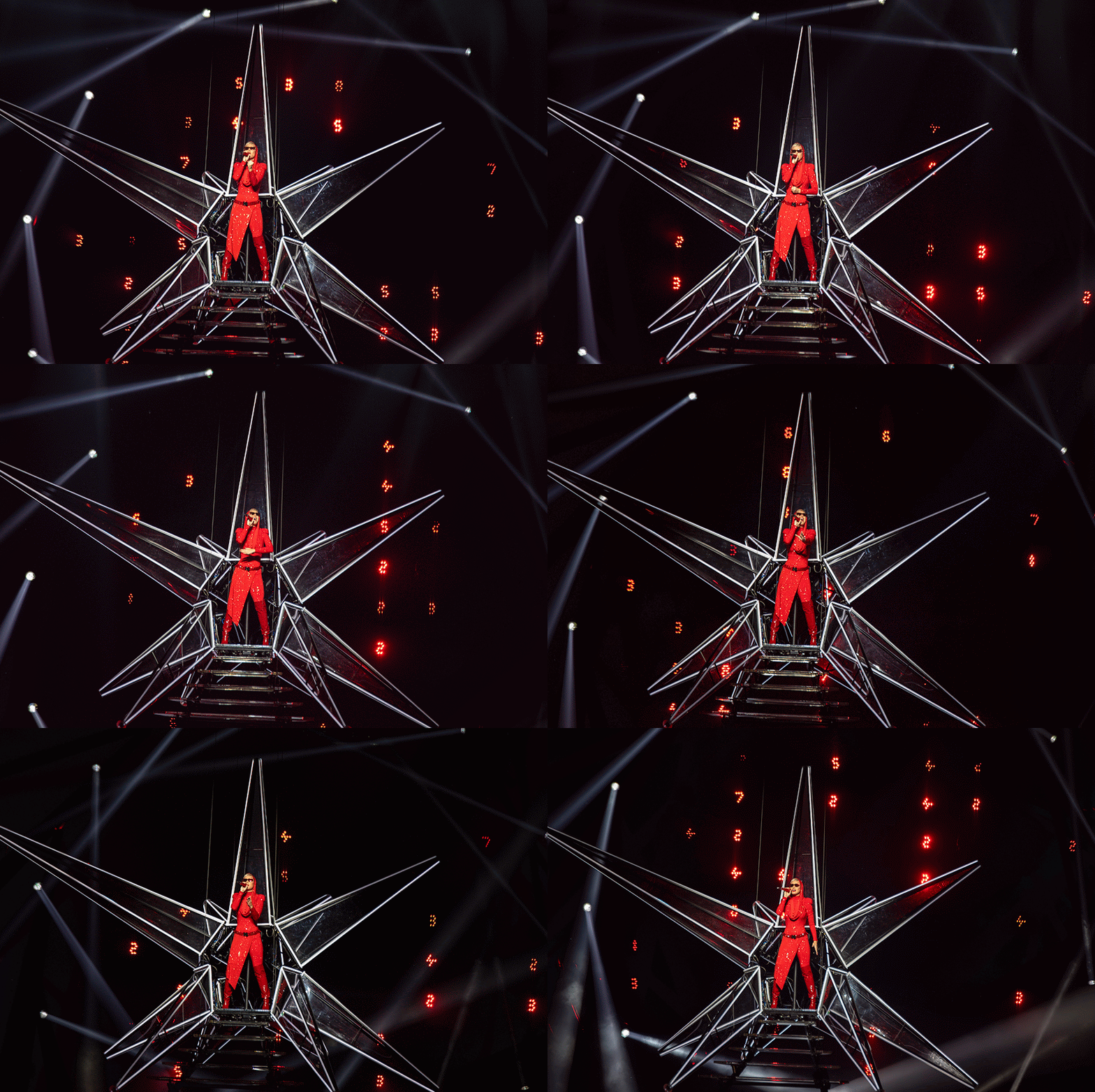
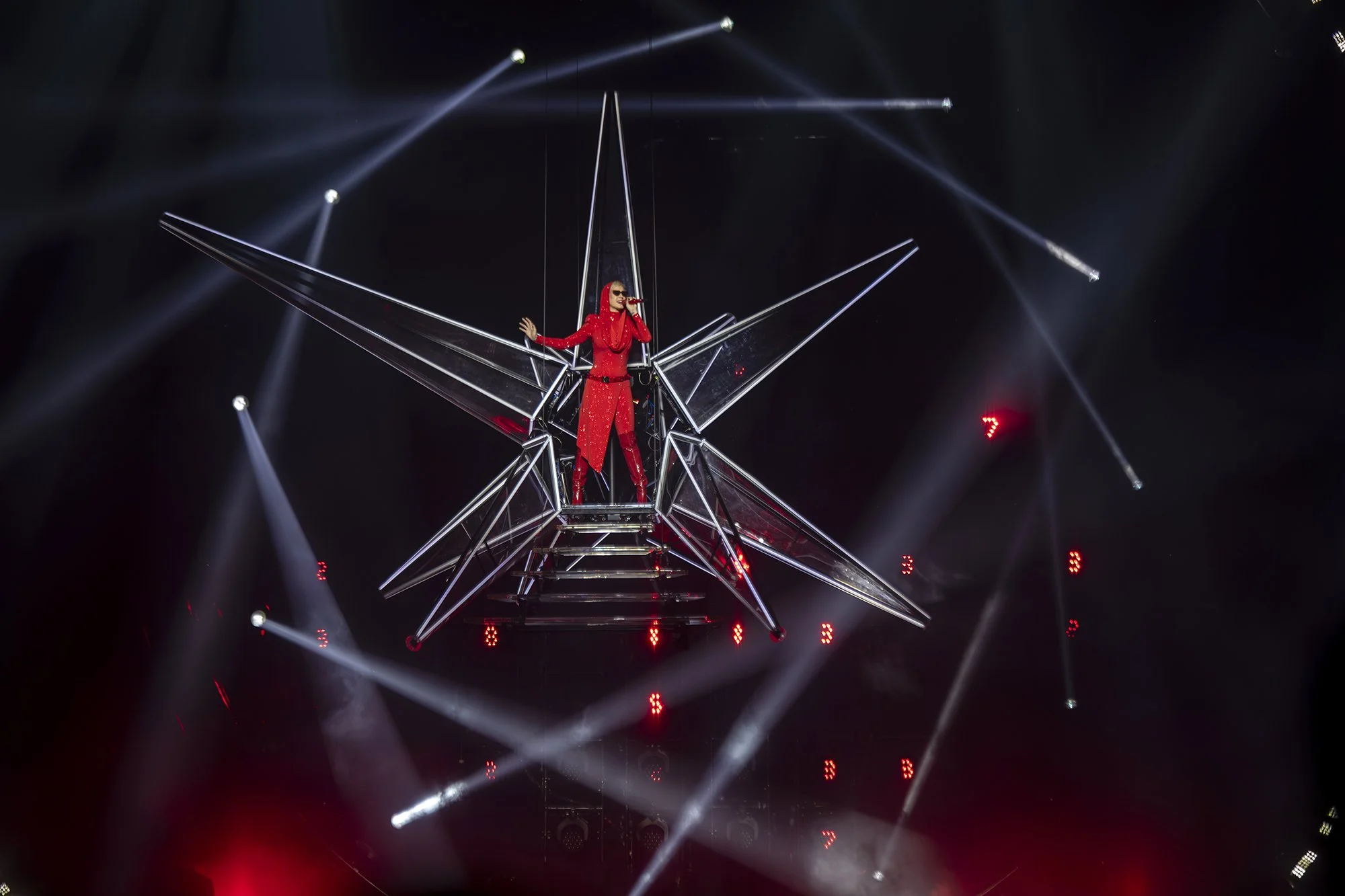
Perry arrived at the Schottenstein Center high in the arena with a transformed silhouette. The platinum pixie cut she had unveiled that spring, after her separation from Orlando Bloom, was the public marker of a stylistic reset, and the tour was meant to be its musical companion piece. Out went the bubblegum primary colors of the Teenage Dream and Prism eras. In came a single dominant palette: deep saturated red, structured tailoring, cobalt eyeshadow against blood-red lipstick. The opening image of the night made the case efficiently — Perry suspended inside a giant chrome star, hooded in red sequins, sunglasses on, descending while the chorus of "Witness" played. It was the visual language of seriousness, of an artist asking to be reconsidered.
The first act delivered on that visual promise. "Roulette" arrived with climbable dice. "Dark Horse" sent Perry and her dancers gliding atop motorized platforms. "Chained to the Rhythm" introduced what became the show's most memorable image: a towering puppet in a pinstripe suit, faceless and enormous, manipulating dancers whose heads had been replaced by static-filled televisions. The song's argument — that pop audiences are willing prisoners of their own distraction — was rendered literal in a way that felt closer to a Saatchi installation than to anything pop tours usually attempt. For about fifteen minutes, the show seemed prepared to follow through on its premise.
What happened next is the question the tour kept failing to answer. The segmented structure — five themed sections plus encore, with titles like "Manifesto," "Retrospective," and "Sexual Discovery" — was meant to organize the evening as a journey of self-examination. In practice, it functioned as a delivery mechanism for the catalog. "Teenage Dream" arrived inside a video interlude built around childhood photos, gestured at as a meditation on aging that lasted exactly until the chorus dropped and the dance break started. "California Gurls" and "Last Friday Night" followed, scrubbed of their original bubblegum framing but still essentially themselves. The thematic scaffolding wasn't wrong, exactly. It was just decorative — a coat of paint applied to a setlist that already knew what it wanted to be.
The new material exposed the gap most plainly. Songs from Witness — the title track, "Roulette," "Swish Swish," "Power" — were given the production's biggest visual investments and the most strenuous staging. They got the puppets and the platforms and the dance corps in latex. What they did not get, with a few exceptions, was the room. The crowd politely waited them out. When "I Kissed a Girl" or "E.T." arrived, the volume of the audience response shifted by an order of magnitude, the kind of swell that tells a performer exactly which songs the audience drove there to hear. Perry, to her credit, seemed to understand this. Her between-song banter was looser and more present than the staged segments around it, and her vocal performances on the older material had a confidence that the new songs couldn't quite earn back.
This is the structural problem of Witness as a tour, and it is worth being direct about it. The show was sold as a maturation — a pop star using her platform to think out loud about consciousness, agency, social media, the ways performance and authenticity rub up against each other. Those are real subjects, and arena pop has handled them before. Madonna's Confessions and Re-Invention tours staged conversations about faith and reinvention with songs built to argue them. Gaga's Born This Way Ball leaned into its own self-mythology with material that had been written to bear the weight. Perry's catalog, accomplished as it is, was not built for that kind of load. The hits are about texture and momentum and the immediate physical pleasure of a chorus arriving on time. Asking them to also be self-interrogations is asking them to do a job they were never designed for.
The production knew this on some level, which is why so much of the show's energy went into the visuals. The TV-headed dancers, the giant pinstriped puppet, the red latex-and-sequins palette, the constant cycling between the towering LED walls and the runway that bisected the floor — every department was firing at full output. Perry's costuming through this stretch was the strongest visual choice of the night: the hooded red sequined catsuit with its broad architectural shoulders, the patent over-the-knee boots, the sharp blue cut of the eye makeup against the dominant warm field. She looked, in those moments, like a pop star who had decided what she meant to communicate. The songs around her hadn't quite caught up.
By the time the show reached its closing sequences and "Roar" landed, the contract between performer and crowd had reset to something simpler than the production had set out to deliver. The conceptual frame had quietly retired. What was left was an experienced pop performer running through a catalog of songs that had carried her through a decade, and a room that was happy to be there for that. "Firework" closed the night, on cue, with the visual finish the song demands.
There is no shame in that ending. It is, in fact, what most arena pop tours do. The shame, such as it is, attaches to the surrounding apparatus — the act titles, the press notes about purposeful pop, the segmented structure that promised an argument and then handed back a setlist. Witness: The Tour built a cathedral. It just forgot to write the sermon, and the congregation, sensibly, sang the songs they already knew.